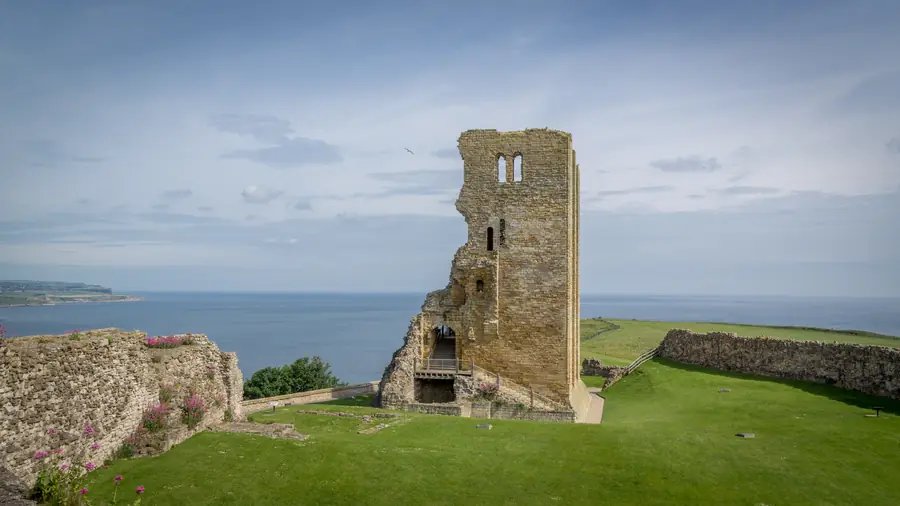
Scarborough Castle occupies the whole headland that divides the town’s two bays, and the site has been fortified more or less continuously for three thousand years.
It is a scheduled monument of national importance, and the reason is that it holds, on one promontory: an Iron Age settlement, a Roman signal station, an Anglo-Scandinavian settlement and chapel, a twelfth-century enclosure castle and an eighteenth-century gun battery.
English Heritage runs it.
The Iron Age. A promontory fort — the headland is defensible on three sides by cliff and on the fourth by a narrow neck.
The Roman signal station, built around AD 370, one of a chain along the Yorkshire coast watching for seaborne raiders and relaying warnings south. Its foundations are visible on the headland, along with a later chapel built over them.
The Norman castle. William le Gros, Count of Aumale, built the first stone castle around 1130. Henry II took it into royal hands and built the great keep in the 1150s — a rectangular tower originally about 30 metres high, of which one half survives.
Sieges. Scarborough was besieged repeatedly. In 1312 Piers Gaveston, Edward II’s favourite, surrendered here and was subsequently murdered. In the Civil War it was besieged twice, and the first siege in 1645 brought down the eastern half of the keep with artillery — which is why the tower is sliced open, and why you can see its internal floors from outside.
The eighteenth century. A battery was built on the headland, and the castle was garrisoned into the modern era.
1914. German battlecruisers shelled Scarborough on 16 December, hitting the castle among much else — one of the first attacks on the British mainland of the war, and a significant shock at the time.
The keep — half a Norman great tower, with the interior exposed like a cutaway drawing. You can go inside and up.
The curtain wall and barbican, a substantial thirteenth-century gatehouse across the neck of the headland.
The headland itself — a large area of open grass with the signal station and chapel foundations, the Master Gunner’s House with an exhibition, and the whole circuit of the cliff edge.
The view is the thing everyone remembers: North Bay on one side, South Bay and the harbour on the other, the town below, and the North Sea. It is genuinely one of the best coastal views in England.
Some visitors think it expensive for what is there, and the specific complaint is that much of what you look at — the keep, the walls — is visible from the town below without paying.
That is partly fair. What the ticket actually buys is the headland: the open ground, the Roman remains, the interior of the keep, the exhibition, and the 360-degree view, none of which you get from the street.
Allow ninety minutes to two hours. Treated as a walk on a historic headland rather than a tour of a building, it justifies itself.
Admission charged; free to English Heritage members. Booking online in summer saves queuing, which visitors specifically mention on hot days.
Access: it is a steep climb from the town, and the site is open grass with slopes and steps. The keep and ramparts involve stairs.
Facilities: shop, toilets, and a café.
Nearby: St Mary’s Church, down the hill, where Anne Brontë is buried — she died at Scarborough in 1849 and is the only Brontë sibling not buried at Haworth.
Fortified since the Iron Age, with a Roman signal station of about AD 370, a Norman castle from around 1130 and a Georgian battery.
Parliamentary artillery brought down the eastern half during the siege of 1645.
Ninety minutes to two hours for the headland, keep and exhibition.
Yes — it is a steep climb from the town, and the site itself has slopes and steps.
Anne Brontë, at St Mary’s, the only Brontë sibling not buried at Haworth.