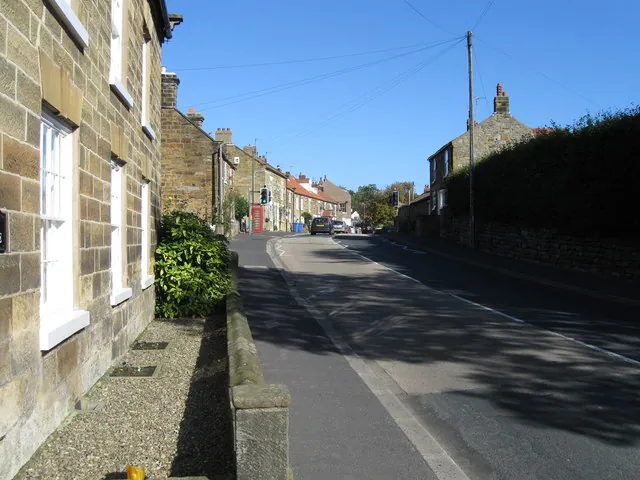
Cloughton (pronounced KLAU-tən) is a small village and civil parish on the A171, the Scarborough to Whitby road. The village is a roadside place — a church, houses, two pubs and a village hall — and the reason to make the trip is not the village but the mile of parish that runs east of it to the sea. That coast holds a wooded ravine where a pair of waterfalls drop onto a pebbly beach, and a bay whose cliffs expose Jurassic rock.
Measured straight-line, it is 6.7 km from Scarborough. Much of the civil parish, but not the village itself, lies inside the North York Moors National Park.
It is genuinely small. The parish had 687 people at the 2011 census, down from 711 in 2001, spread across 5.06 square miles (13.1 km2). It reaches 1 mile (1.6 km) east to the coast and 3 miles (4.8 km) north of the village, taking in the hamlet of Cloughton Newlands. The Duchy of Lancaster, a private estate of the British sovereign, owns 2,375 acres (961 ha) of land here along with several businesses.
Hayburn Wyke is the draw. It is a Site of Special Scientific Interest: a secluded bay reached by a short but steep path from the cliff top. The beach is pebbly, not sandy, and a pair of waterfalls cascade from the woods above down to it. The Hayburn Wyke Inn stands at the top of the cliffs, with food, beer and overnight accommodation, and there is road access to the inn itself.
The waterfall listing carries 4.5 from 437 Google reviews, and the reviews are consistent about one thing: the descent. A visitor in July 2026 wrote, “Signposted from the Hayburn inn (which has ample car parking places) The is a lot of steps so not ideal for those who struggle with inclines or for prams.” A visitor in August 2026 put the same warning differently: “It is a beautiful peaceful place, But is very rocky terrain to get to for anyone with mobility issues.”
Take that at face value: a walk down and a climb back, over rock, to a beach of pebbles. The bay can also be reached on foot: the Cleveland Way and the Cinder Track run close together here.
South of Hayburn Wyke the coast runs out into two promontories, Iron Scar and Hundale Point, with the bay of Cloughton Wyke between them. They form part of a second SSSI that stretches almost to Scarborough and exposes an important selection of rocks from the Jurassic period.
Cloughton Wyke can be reached from the Cleveland Way, or by road from the village along Salt Pans Road. The name is not decorative: local maps mark the former salt pans in the bay. As a listed attraction the bay carries 4.8 from six Google reviews, far too small a sample to mean anything. Long Nab Bird Observatory, also listed here, has 4.6 from 29 — again a handful of opinions rather than a verdict.
For a parish of under 700 people, Cloughton has four public houses: the Blacksmiths Arms and the Red Lion in the village, the Bryherstones Country Inn at Cloughton Newlands, and the Hayburn Wyke Inn out at the coast.
The Bryherstones carries 4.8 from 783 Google reviews, the strongest score of anything listed here; a visitor in July 2026 wrote of “Proper home-cooked pub food, cooked to perfection”. The Blacksmiths Arms, which also offers accommodation, carries 4.5 from 614 reviews, and a visitor in August 2026 called it a “Lovely quaint pub, staff were very friendly and welcoming”. Cober Hill, a hotel in the village, has 4.5 from 226 reviews.
One place divides people sharply, which matters if you are considering staying. Applegrove Country Park, a holiday park, carries 3.9 from 382 Google reviews. A visitor in August 2026 wrote that “on arriving we was amazed of how clean, safe and secure the site was”. A visitor in July 2026 wrote the opposite: “Absolute hell-hole arrived to bland caravan park, no lodges they are caravans with decking, dirty, dilapidated and neglected”. Read the recent reviews yourself before booking.
The settlement appears in the Domesday Book as Cloctune, and the name translates from Old English as the town (tūn) in the valley (clōh) — the shape of the ground it sits in.
There has been a church here since mediaeval times, but the present St Mary’s dates from 1831, when its predecessor was demolished. In that same year the village became part of the parish of Scalby; in 1874 it was formed into its own chapelry with Burniston and Staintondale, and in 1889 St Mary’s was restored and extended. The parish holds 13 listed structures, all at Grade II, the lowest grade: St Mary’s, the late 17th-century Blacksmiths Arms, the war memorial and mostly houses.
Two names attach to the place. Sir Frank Lockwood (1846–1897), a lawyer, Liberal politician and Solicitor General for England and Wales, lived at Cober Hill; in 1895 he was lead counsel for the prosecution of Oscar Wilde. G. P. Taylor, author of Shadowmancer and Wormwood, was vicar at St Mary’s.
The A171 runs straight through the village and carries the X93, a regular bus service connecting Middlesbrough, Whitby and Scarborough — the simplest way out without a car.
The other route is the old railway. Between 1885 and 1965 Cloughton had its own station on the Whitby to Scarborough line, and a further station at Hayburn Wyke brought tourists to the coast. The abandoned trackbed is now the Cinder Track, a traffic-free trail of about 21 miles forming part of National Cycle Route 1 and running through Cloughton, Hawsker and Robin Hood’s Bay. In Scarborough you join it behind the Sainsbury’s just off Falsgrave Road. It is level going, but it winds a mile or two inland, so sea views are limited, and it is shared with walkers and horse riders. The compacted surface suits hybrids and mountain bikes better than road bikes, which meet rough sections, particularly after wet weather.
On foot, the Cleveland Way runs along the clifftops in the east of the parish, linking Hayburn Wyke and Cloughton Wyke to each other and back to Scarborough.
The village and what is around it, at walking scale.
Open any of them in Google Maps for directions and current opening.
Attractions, prices and availability in Scarborough
These come from GetYourGuide's booking widget, which sets their cookies in your browser. Consent to load it and see the attractions and prices.
Background on Cloughton draws on its Wikipedia article, text there being available under CC BY-SA 4.0.