Filey is a seaside town and civil parish on Filey Bay, on the coast between Scarborough and Bridlington, with a parish population of 6,981 at the 2011 census. It was a fishing village before it was a resort, and it has a large sandy beach; the reason to make the trip from Scarborough is largely what is missing from the front rather than what is on it. A visitor in August 2026 put it plainly: “Filey is an ideal place as its not too busy but plenty of eating places and a few good shops.”
The straight-line distance from Scarborough town centre is 10.8 km, and the pattern of the visit is old: Filey was a small village until the 18th century, when people from Scarborough began arriving in search of the peace and quiet it then offered.
The bay is closed at its northern end by Filey Brigg, a rock projection that may have named the town. One theory takes Filey from the Old English fīfelēg, ‘monster island’, after the shape of that rock; others propose ‘five woods or clearings’, or an Old Norse word for cottongrass.
Filey Beach carries 4.7 from 3,410 Google reviews, and the reviews keep returning to the same two things: length, and the absence of amusements. A visitor in August 2026 wrote, “Beautiful long (long!!) beach. Some sea side cafes at its head and no tat shops or arcades”, and added that the council had recently installed portaloos on the front. A Coble Landing Fun Park is listed at 4.8 from 13 Google reviews, too few to weigh.
The town is not on the beach; it sits above it, and the connection is a climb. A visitor in July 2026 wrote, “Lovely beach and if you go up a steep slope, you can find the town centre.” If the climb is a problem, do it in that order.
Filey Brigg Country Park, 4.6 from 2,667 Google reviews, sits on the cliffs at the north end of the bay, with a café, toilets and a caravan site. A visitor in July 2026 described it as “situated on the cliffs and so plenty of views and you can walk down to Filey beach via several paths or trackway”, and reported that the toilets were now charged for.
Parking is paid, and the queue to pay is what reviewers flag. A visitor in June 2026 advised, “Better to drive in, park your car where you want, and pay on RingGo”, giving the location code 4636, after watching people queue at the entrance and block the traffic. A one-star review in July 2026 concerned the caravan site rather than the cliffs: that visitor wrote, “We were woken 19th July 2026 by a masked man in our awning”, and complained that staff were not there overnight. It is one review among thousands, and it matters more to anyone staying than parking.
The headland above the Brigg is Carr Naze, where in 1857 the foundations of a 4th-century Roman signal station were found at the cliff edge: a structure 160 feet (50 m) long with a square tower 46 feet (14 m) wide. Excavations turned up Roman pottery and hoards of coins. The site is a protected Scheduled Monument, and the find supports the case for Filey being the Roman settlement of Portus Felix.
Glen Gardens, 4.6 from 2,272 Google reviews, works as a route as much as a destination: a visitor in August 2026 wrote, “A pleasant walk through to the town. We always have a pitstop at the cafe”. Filey Zoo carries 4.6 from 2,405, and reviewers who like it still warn about its scale — a visitor in August 2026 wrote, “it’s a lovely little place but honestly I’d take zoo out of the title. You can walk around and see everything within 2 hours easy”, adding that the play park was tired. Others rate the keeper talks highly.
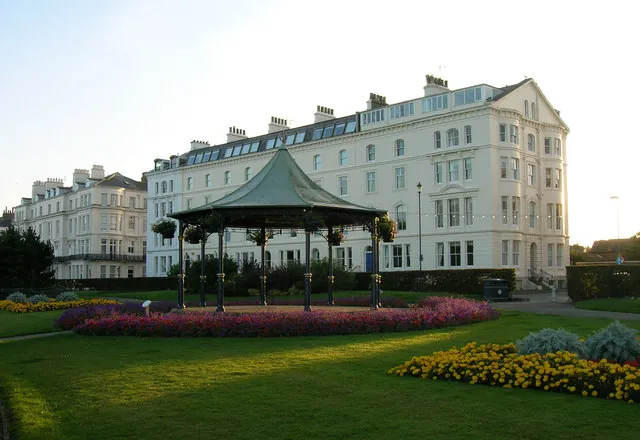
The Crescent, later the Royal Crescent, was built after a Birmingham solicitor, John Wilkes Unett, bought 7 acres (2.8 ha) here in 1835, and opened in the 1850s. Charlotte Brontë came several times in the mid-19th century hoping to recover her health, and wrote to her father in June 1852: “The Sea is very grand.”
St Oswald’s, on Church Hill in the north of the town, is 12th century, Grade I listed and the oldest building in Filey; Nikolaus Pevsner rated it easily the finest church in the north-east corner of the East Riding. On the roof of its tower are nearly 1,500 pieces of well-preserved medieval graffiti, from initials to detailed drawings of fully rigged sailing vessels, one of them a Whitby Cat. The marks span about 400 years and were recorded by Historic England in 2016.
The fishing boats here are cobles, as along the rest of the Yorkshire and North East coast, and the catch is mostly sea trout; limits on the nets, which also trap salmon, have led some to fear the trade will end. A lifeboat was bought for the town in 1804 and became an RNLI asset in 1852, and the station still has an inshore and an all-weather boat.
The modern shape of the town owes a good deal to Butlin’s. The holiday camp, begun in 1939 and used during the Second World War as RAF Hunmanby Moor, opened in 1945, gained its own branch line and station on 10 May 1947, and by the late 1950s could take 10,000 holidaymakers. It closed in 1984 and visitor numbers fell with it. The site is now The Bay Filey, a 600-home holiday housing development, the first homes finished in 2007.
The train is the established link. Filey has a station on the Yorkshire Coast Line, run by Northern, which works up the coast roughly every two hours from Hull via Beverley, Bridlington and Bempton. Trainline’s fastest-journey table gives Filey to Scarborough as 15 minutes. The station carries 4.4 from 51 Google reviews. No bus route between the two towns appears in the transport listings, so do not count on one.
On foot, the coast path arrives here: the Cleveland Way, opened in 1969 as the second National Trail, begins at Helmsley, skirts the North York Moors, passes the north side of Scarborough and finishes at Filey. The town’s second station, at the old holiday camp to the south, is closed.
The village and what is around it, at walking scale.
Open any of them in Google Maps for directions and current opening.
Attractions, prices and availability in Scarborough
These come from GetYourGuide's booking widget, which sets their cookies in your browser. Consent to load it and see the attractions and prices.
Background on Filey draws on its Wikipedia article, text there being available under CC BY-SA 4.0.