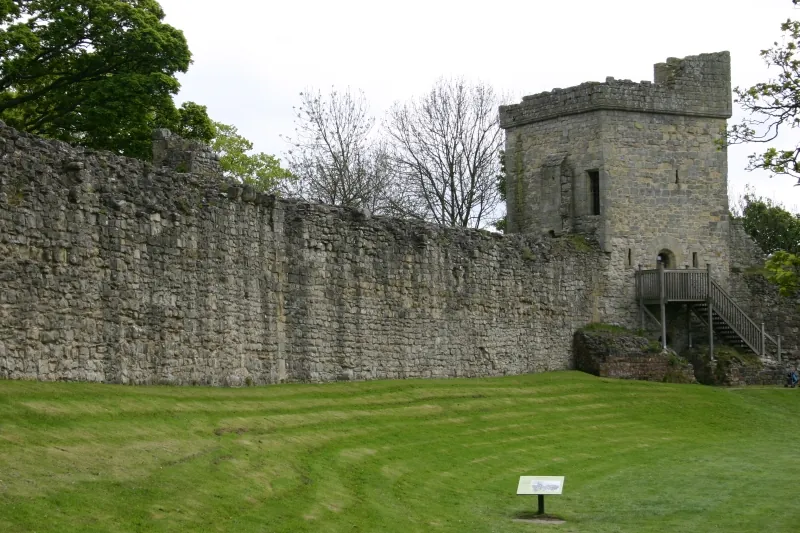
Pickering Castle stands on a spur above the town of Pickering, twenty-five kilometres west of Scarborough at the southern edge of the North York Moors.
It is a motte-and-bailey castle — a mound with a tower on it, and two enclosed courtyards below — and it is one of the clearest and most legible examples of the type in England, because it was never substantially rebuilt in a later style.
It belongs to the Duchy of Lancaster and is managed by English Heritage.
The first castle was timber, raised soon after the Conquest as part of the Norman pacification of the north. Stone came later: a shell keep on the motte from the twelfth century, curtain walls and towers in the thirteenth and fourteenth.
Climbing the motte to the keep is the highlight, and visitors say so unanimously. The view from the top takes in the town below, the Vale of Pickering, and the moors rising to the north.
Three towers survive on the outer curtain — Rosamund’s Tower, Mill Tower and Diate Hill Tower — along with the chapel and the outlines of the hall and domestic ranges.
Pickering was a royal hunting castle rather than a frontier fortress. It sat at the edge of the Royal Forest of Pickering, and it was used by a succession of kings coming north to hunt — John, Henry III, Edward I, Edward II and Richard II among them.
Richard II was held here briefly as a prisoner in 1399, on his way from Conwy to Pontefract and his death — the deposition that put Henry Bolingbroke on the throne.
It never saw a serious siege, was never slighted, and simply fell into disuse, which is why the plan is so easy to read.
Volunteer-staffed, and the volunteers attract consistent and specific praise — knowledgeable and genuinely welcoming.
The guidebook is worth buying. More than one visitor makes the point that the site rewards knowing what you are looking at, and that the guidebook is what supplies it. There is limited on-site interpretation.
Time: an hour to ninety minutes.
Space for a picnic — the baileys are open grass and are one of the better picnic spots in the area.
Pickering is the southern terminus of the North Yorkshire Moors Railway, one of the finest preserved steam lines in the world, running twenty-nine kilometres across the moors to Grosmont, and on to Whitby.
Arriving at Pickering by steam train from Whitby or Goathland and walking up to the castle is much the best way to do it, and it turns a castle visit into a full day.
By road it is about thirty minutes from Scarborough on the A170.
Admission charged; free to English Heritage members.
Parking: a small free car park just outside the entrance, with toilets.
Time: an hour to ninety minutes.
Access: the baileys are grass with slopes; the motte is a steep climb and the keep involves steps.
Season: seasonal opening — check before travelling.
Pickering is a good market town with a parish church holding one of the most complete sets of medieval wall paintings in England — fifteenth-century, whitewashed at the Reformation, rediscovered in 1852, and remarkable. It is free.
A motte-and-bailey — a mound with a shell keep and two enclosed courtyards — unusually legible because it was never rebuilt in a later style.
Richard II, briefly, in 1399, on the journey that ended in his deposition and death.
Yes, a small free car park just outside the entrance, with toilets.
Thirty minutes by road, or by the North Yorkshire Moors Railway steam line, which terminates at Pickering.
Visitors strongly recommend it — on-site interpretation is limited and the guidebook makes the site much more rewarding.