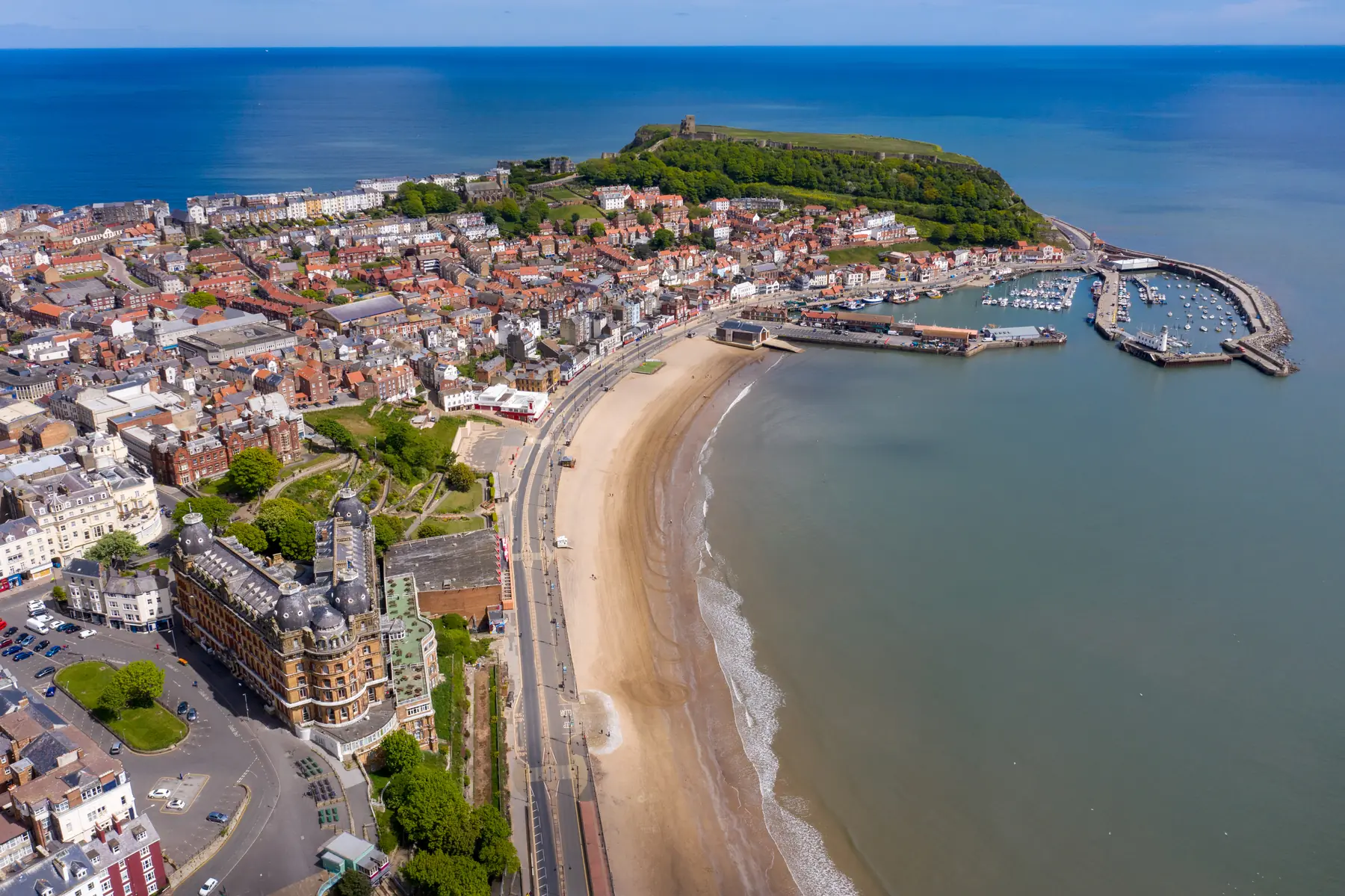
Scarborough is built around a headland with a bay on either side of it, and that shape makes the walking here unusually easy to plan. The Cleveland Way national trail runs along the clifftop through the town, north towards Robin Hood’s Bay and Whitby and south towards Filey Brigg. Inland, the North York Moors begin about ten kilometres out and the wooded valley of the Derwent runs west.
Almost everything below can be reached by bus or train, which matters on a coast where the walking is linear.
Distances are from the town centre.
The essential Scarborough walk. Start on South Bay by the harbour, climb through the old town past St Mary’s Church — where Anne Brontë is buried, having come here in 1849 hoping the sea air would help and dying within days of arriving — and up onto the headland to Scarborough Castle.
The castle occupies a rocky promontory that has been fortified since the Iron Age, with a Roman signal station on it and a Norman keep above the sea. The views run the length of both bays.
Come down the northern side to North Bay, past the Sea Life centre and Peasholm, and back along the seafront. About six kilometres with two climbs, and it takes in most of what Scarborough is.
The Scarborough Spa complex sits at the southern end of South Bay, built where a mineral spring was found in 1626 and claimed to be medicinal — the discovery that turned a fishing town into Britain’s first seaside resort. There is a Victorian complex of halls and terraces, a cliff lift running up to the Esplanade above, and the Italian Gardens and South Cliff Gardens on the slope.
The walk south along the front to the Spa and up through the gardens is level then steep, and the cliff lift removes the steep part if you would rather.
Behind North Bay, Peasholm Park opened in 1912 as an oriental-themed municipal park and remains one of the finest in the country: a lake with an island and a pagoda, boats for hire, a bandstand and steeply wooded slopes. The Northstead Manor Gardens beyond it hold the open-air theatre and the miniature railway.
Flat, free and about an hour.
The hill immediately south of the town, with a war memorial and a viewing point at the top and a motor racing circuit on its flanks — the only naturally formed road racing circuit in Britain. The climb from the town takes about forty minutes and the view over both bays and inland to the Wolds is the best from any accessible point here.
The national trail runs from Scarborough up the coast to Whitby and beyond, and the sections nearest the town are excellent.
Scalby Mills to Hayburn Wyke — about nine kilometres of clifftop past Scalby Ness and Cloughton Wyke to Hayburn Wyke, where a waterfall drops directly onto a boulder beach in a wooded ravine. There is a pub at the top and a bus back.
Hayburn Wyke to Ravenscar continues north, past the old alum works and the strange half-built resort at Ravenscar that was laid out in the 1890s and never finished — streets and drains on a clifftop with almost no houses.
Ravenscar to Robin Hood’s Bay brings you down into the village, which is the classic Yorkshire coast walk.
The Cinder Track, the old railway line from Scarborough to Whitby, runs parallel inland and is a level walking and cycling route for the whole thirty-five kilometres.
Scarborough to Cayton Bay — about six kilometres along the cliffs above the South Bay, past the Spa and out to a wide surf beach in a wooded bay.
Cayton Bay to Filey — continues to Filey Brigg, a narrow rock promontory running out to sea at the end of Filey Bay, which is where the Cleveland Way ends after a hundred and ten miles from Helmsley. Filey has a train back.
Forge Valley, ten kilometres west near West Ayton, is a steep wooded gorge cut by the Derwent, with a boardwalk trail through it and a national nature reserve. It is one of the best places on the coast for woodland birds and it is level and easy.
Raincliffe Woods and Throxenby Mere adjoin it.
The North York Moors National Park begins about ten kilometres inland, with heather moorland, the Hole of Horcum and Levisham within half an hour.
Trains run north to Whitby only by bus, but south to Filey, Bempton and Bridlington, and west to Malton and York, which covers several linear walks.
Buses run up the coast to Cloughton, Ravenscar, Robin Hood’s Bay and Whitby, and are the way to do the Cleveland Way in day sections.
The cliffs here are soft and actively eroding, with landslips a regular occurrence — the Holbeck Hall Hotel famously slid into the sea in 1993. Paths are diverted from time to time; follow the current signs.
Parking is free at several central car parks including West Pier, North Street and Castle Road, and there are park and ride sites on the Seamer Road and Filey Road approaches.
Tides matter on the beaches below the cliffs, several of which are cut off at high water.
Spring brings the seabirds back to the cliffs and the woods into leaf at Forge Valley. The Cleveland Way is quiet and the paths are drying out.
Summer fills the beaches and, oddly, empties the clifftops — most visitors go no further than the promenade, so an hour’s walk north or south gets you real solitude even in August. It also brings sea fret, the cold fog that rolls in off the North Sea and can sit over the coast while the moors ten kilometres inland are in sunshine.
Autumn is the best walking of the year: the moors turn, the light comes in low, and the cliffs are at their clearest.
Winter is when the North Sea puts on its show. Marine Drive in a gale, the waves over the sea wall and the castle headland in a storm are worth a trip on their own — from a safe distance.
The Yorkshire coast is one of the best in England for it. Seabirds crowd the cliffs from April to July, with the great colony at Bempton Cliffs thirty kilometres south. Grey and common seals are seen from the shore and from the boat trips. Porpoises are regular offshore, and minke whales and dolphins pass in late summer — the coast north of here has become a recognised whale-watching spot in August and September.
Inland, Forge Valley is a national nature reserve and one of the best woodland bird sites in Yorkshire.
And under your feet: this is a Jurassic coast, and the beaches shed ammonites, belemnites and occasionally dinosaur footprints. Collect from the beach, never from the cliff.
The two bays and the headland for the town; Scalby Mills to Hayburn Wyke for the coast; Oliver’s Mount for the view.
From Helmsley over the North York Moors to Saltburn, then down the coast through Whitby, Robin Hood’s Bay and Scarborough to Filey Brigg — 110 miles in total.
Yes, along the Cleveland Way in two days, or on the level Cinder Track — the old railway — in one long one.
The seafronts, Peasholm Park, Forge Valley’s boardwalk and the Cinder Track.
In St Mary’s churchyard below the castle, where she was buried in 1849.