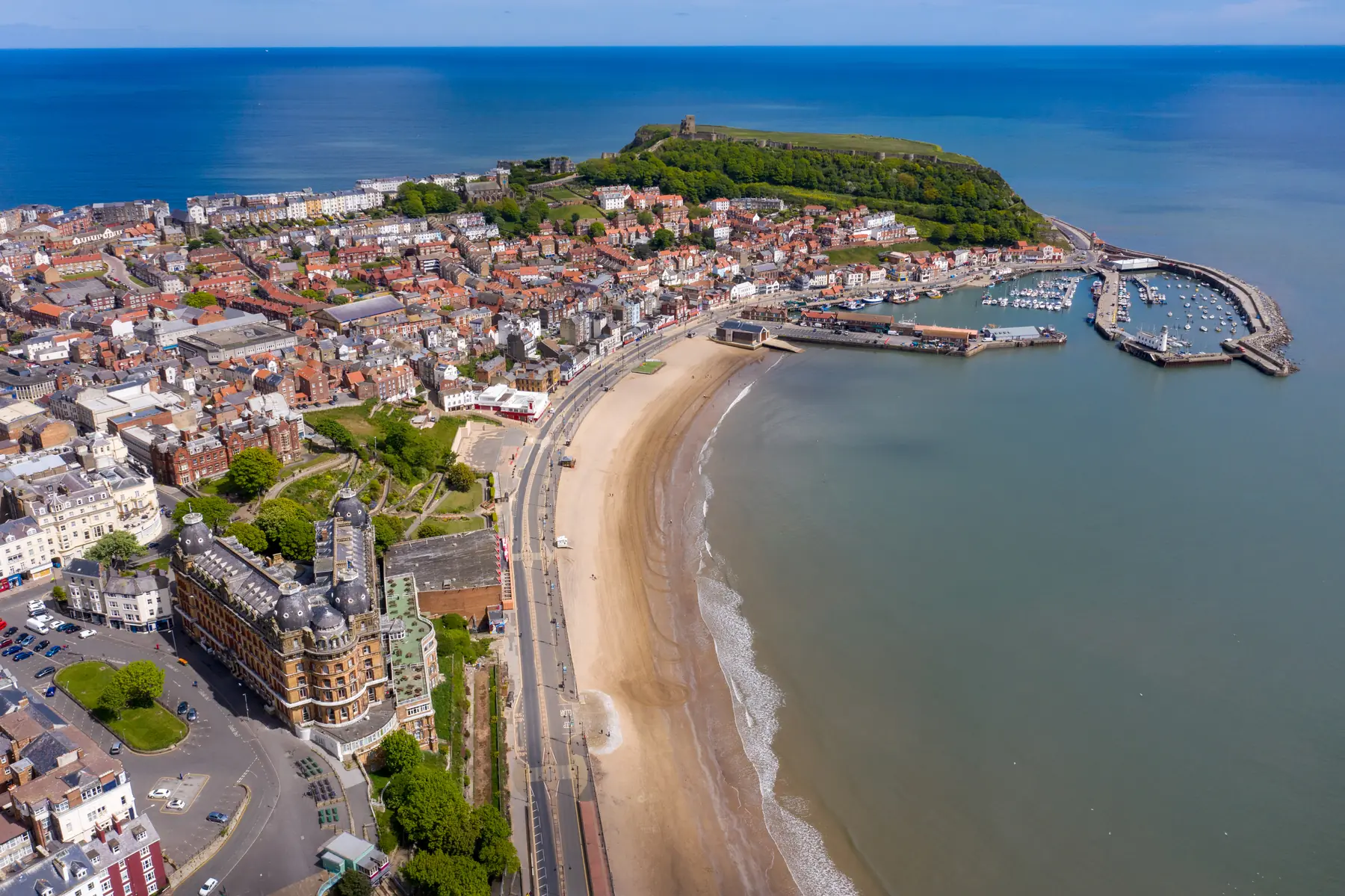
Scarborough is two seaside towns with a castle between them. The headland divides the coast into South Bay and North Bay, and they developed in different centuries for different reasons — which is why they still feel like different places, and why the answer to “which beach” depends on what you want and which way the wind is blowing.
The original one. The town grew along the sheltered southern side because there was a harbour there, and the spring that made Scarborough a resort comes out of the cliff at the far end.
The beach is a broad curve of sand between the harbour and the Spa, with Foreshore Road running behind it — amusements, arcades, chip shops, the Luna Park funfair and, in season, donkeys on the sand. It is the traditional, cheerful, slightly gaudy English seaside, and it does not pretend otherwise.
The harbour at the northern end still lands fish. Boats come and go, crab pots are stacked on the quay, and short speedboat and sea trips run from the West Pier in summer.
The Spa at the southern end is the reason for all of it. In 1626 a mineral spring was found bubbling from the cliff and claimed to be medicinal; people came for the cure, then for sea bathing, and Scarborough became the first English seaside resort. The Victorian Spa complex that grew up around it is a pile of halls, terraces and a theatre, still running concerts and shows, with a cliff lift climbing to the Esplanade above.
The South Cliff Gardens above the Spa are Victorian cliff gardens restored in recent years — the Italian Gardens, a rose garden and paths zig-zagging up the slope. Free and among the best public gardens on the east coast.
Developed after the railway arrived in 1845, when Scarborough expanded and the grand hotels went up. It is wider, quieter and less commercial than South Bay.
The beach is a long sweep of sand backed by the Marine Drive and the cliff, with far fewer arcades and considerably more space. At low tide it is very large indeed.
Behind it, in order from the headland:
Peasholm Park, opened in 1912, oriental-themed and one of the finest municipal parks in England: a lake with a pagoda island, boats for hire, a cascade down a wooded slope, and the Naval Warfare model warship battles that have run since 1929.
Northstead Manor Gardens, with the open-air theatre — the largest of its kind in Europe, cut into a hillside with a lake between the audience and the stage.
The North Bay Railway, a twenty-inch gauge miniature line built in 1931 running about a mile and a half from Peasholm to Scalby Mills.
SEA LIFE Scarborough and Alpamare at the Scalby Mills end.
This is the practical question and the answer is the wind.
Northerly or easterly wind: South Bay is sheltered by the headland.
Southerly wind: North Bay is in the lee.
A big sea: Marine Drive round the headland closes when the waves come over, which is worth seeing from a safe distance.
Sun: South Bay faces east and gets the morning; North Bay faces north-east and holds the light differently. Both are sunniest in the middle of the day.
Crowds: South Bay is always busier. North Bay is the better beach day.
The road round the base of the headland connecting the two bays, built between 1897 and 1908 and still one of the best short walks in Scarborough — sea on one side, cliff and castle above, and the whole thing at wave height.
It closes in heavy weather. When it does, the sea coming over it is a considerable spectacle from the safe end.
Cayton Bay, five kilometres south, is a wide surf beach in a wooded bay with a surf school and a National Trust car park above it. It is the surfing beach for Scarborough.
Scalby Ness and the small coves north towards Cloughton are rocky and good for pools.
Filey, eleven kilometres south and twelve minutes by train, has miles of firm flat sand and is the best beach on this stretch of coast for young children.
Tides. South Bay’s sand shrinks considerably at high water; North Bay holds more. The beaches below the cliffs north of the town can be cut off.
Lifeguards patrol the main beaches in season.
Parking is free at West Pier, North Street, Castle Road and Sea Cliff Road, and there are park and ride sites on the Seamer Road and Filey Road approaches for summer weekends.
Getting between the bays. On foot round Marine Drive in about twenty-five minutes, over the headland past the castle, or on the bus. The cliff lifts serve the South Bay side.
Dogs face seasonal restrictions on the main beach areas through the summer; check the signs.
The story is worth knowing because it explains the shape of the seafront.
In 1626 a woman named Elizabeth Farrow noticed a spring running from the cliff at the southern end of South Bay, staining the rocks with its mineral content. The water was declared medicinal, visitors came to take it, and by the end of the century Scarborough had a spa.
In the eighteenth century the fashion shifted from drinking the water to bathing in the sea, and Scarborough — which had the water, the sand and a reputation — became the first English seaside resort. Bathing machines appeared on South Bay; the first known image of one in England is a Scarborough print.
The railway arrived in 1845, and everything changed scale. Grand hotels went up along the cliffs, the town expanded northwards into what became North Bay, and the two-bay resort you see now took shape within about fifty years.
That is why the seafront looks the way it does: a Victorian resort laid out on a Georgian spa town, on either side of a Norman castle, on a headland people have been using since the Bronze Age.
Getting between the bays takes about twenty-five minutes on foot round Marine Drive at sea level, a little longer over the headland past the castle, or a few minutes on the bus. The North Bay Railway covers the far end of North Bay.
Facilities. Both bays have toilets, cafés and lifeguards in season. South Bay has considerably more in the way of food, amusements and deckchairs; North Bay has more space and fewer people.
Deckchairs and windbreaks are hired on South Bay in season. A windbreak is not a tourist affectation on this coast — the North Sea breeze is constant and cold even on a warm day.
Sea temperature here peaks in August and September and is never warm. Wetsuits are normal for anything more than a paddle, and the surf schools at Cayton hire them.
Worth a mention. South Bay’s Foreshore Road lights up in the evening and the town runs a programme of seafront events through the summer, including fireworks on set nights. The open-air theatre in Northstead Manor Gardens on the North Bay side puts on concerts through the season with the audience on one side of a lake and the stage on the other, which is a striking way to see a show.
And on a clear night the headland is one of the better places on the east coast to look at the sea in the dark, with the lights of the two bays curving away on either side.
North Bay for a beach day — wider, quieter and sandier. South Bay for the harbour, the amusements and the traditional seaside.
Yes, both bays are sand, with a good deal more exposed at low tide.
The Victorian complex at the southern end of South Bay, built around the mineral spring found in 1626 that made Scarborough the first English seaside resort. It still runs concerts and shows.
Yes — the Spa cliff lift runs from South Bay up to the Esplanade, and is one of the oldest funiculars in the country.
Cayton Bay, five kilometres south, which has a surf school and a National Trust car park.