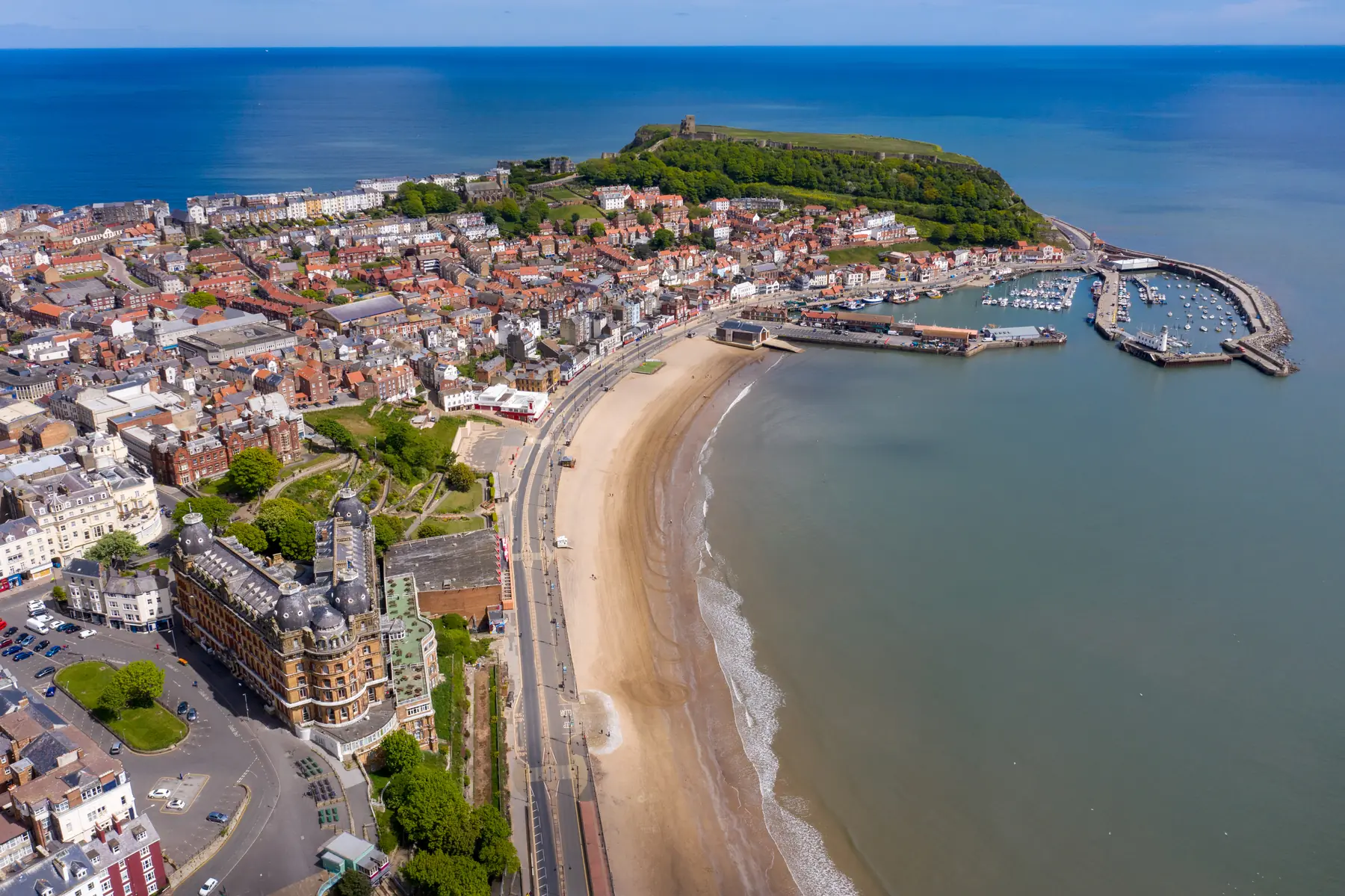
Scarborough is a full-sized town of sixty thousand people rather than a resort strip, and that is its wet-weather advantage. There are museums, a serious producing theatre, a Victorian spa complex, an indoor waterpark, a shopping centre and a great many pubs, all within walking distance of each other.
The North Sea coast also delivers its weather in bands rather than continuously, so a wet morning here frequently clears by lunchtime — and the light on the two bays after a squall is the best you will get.
On Vernon Road below the Esplanade, and much more interesting than its size suggests. It is one of the oldest purpose-built museums in Britain, opened in 1829 and designed as a circular gallery so that the rock strata of the Yorkshire coast could be displayed in the order they occur — an idea of William Smith, the man who made the first geological map of England and lived in Scarborough.
It is now the museum of coastal heritage and geology, which on this coast means dinosaurs: the Yorkshire coast is one of the best fossil coastlines in Britain. An hour and a half.
On The Crescent, in a Victorian villa, with a collection focused on the town and the coast — including work by Atkinson Grimshaw and a good deal of local topographical painting. Small, quiet and inexpensive, and there is a joint ticket with the Rotunda.
A waterpark on the North Bay cliff with indoor slides, pools, a lazy river and outdoor thermal pools that are heated year-round and look out over the sea. Sitting in a warm outdoor pool watching rain come in off the North Sea is one of the better wet-day experiences in Yorkshire.
At Scalby Mills at the far end of North Bay, with a seal rescue centre, penguins, otters and sharks. Half a day, entirely indoors, and reachable by the miniature railway or the bus.
The Scarborough Spa complex at the southern end of South Bay is a Victorian pile of halls, terraces and a theatre, built around the mineral spring discovered in 1626 that started the whole resort. It runs a programme of concerts, shows and tea dances, and the cliff lift up to the Esplanade is a small pleasure in itself.
Scarborough’s producing theatre, in a converted Odeon cinema in the middle of town, and one of the more significant regional theatres in Britain — Alan Ayckbourn ran it for decades and premiered most of his plays here. It performs in the round, which is unusual and works very well. There is also a cinema screen and a café.
A matinee here is the best wet afternoon in Scarborough.
The lanes climbing from the harbour towards the castle — Eastborough, Princess Street, Quay Street — are narrow, old and full of small shops, cafés and chip shops. The Brunswick Centre covers the covered shopping.
Scarborough Castle is roofless, but the exhibition in the master gunner’s house gives some shelter and the site is worth walking in weather — the headland in a North Sea gale is a considerable sight.
Whitby, thirty-five kilometres north, has the abbey, the Captain Cook Memorial Museum, the whalebone arch and a great many indoor attractions in a small area. An hour by bus along the coast.
Pickering, twenty-five kilometres west, has a motte-and-bailey castle where Richard II was briefly imprisoned, the Beck Isle Museum of rural life, and the terminus of the North Yorkshire Moors Railway — a heritage steam line running to Whitby, which is a superb thing to do in bad weather because you are sitting in a warm carriage watching the moors go past.
York, seventy kilometres west and about an hour and a quarter, has the Minster, the Jorvik Centre, the Railway Museum and a city’s worth of covered shopping. The obvious full wet-day escape, and the train goes there.
Hunmanby, twelve kilometres south, has the Spirit of Yorkshire Distillery — Yorkshire’s first single malt whisky distillery — with tours and a restaurant.
Forge Valley, ten kilometres west, is a wooded gorge with a boardwalk trail, sheltered and level.
Peasholm Park has tree cover and a lake, and is at its most atmospheric in drizzle.
The seafronts are exposed but short, and both bays have shelters. Watching a big sea come into South Bay from behind the harbour wall is free and memorable.
Avoid the cliff paths in heavy rain — the cliffs here are soft and actively slipping, and the Cleveland Way sections north and south of the town get greasy.
Trains run to York in about an hour and a quarter, and to Filey, Bridlington and Hull down the coast. The station is in the middle of town.
Parking is free at several central car parks and fills faster in bad weather.
Seasonal closing. The Rotunda, the art gallery and several attractions have reduced winter hours; the theatre and Alpamare run year-round.
Two bays. If the wind is northerly, South Bay is sheltered, and vice versa. It genuinely makes a difference.
The shape that works: the Rotunda Museum first thing — an hour and a half, five minutes from the seafront, and the best thing in Scarborough that most visitors never enter. Lunch in the town centre. Then either Alpamare for the afternoon, which puts you in a heated outdoor pool watching the rain come in off the North Sea, or a matinee at the Stephen Joseph Theatre. Finish with fish and chips.
If the rain has set in for the week, the train to York is the answer — an hour and a quarter, and a city’s worth of indoors at the far end.
A local phenomenon worth knowing about. Sea fret — called haar further north — is a cold fog that forms over the North Sea and rolls inland, most often in late spring and early summer. It can sit on the coast all day while the moors ten kilometres inland are in full sunshine, and it drops the temperature sharply.
The practical response is to go inland. Pickering, the moors and Forge Valley are frequently clear when Scarborough is grey, and the North Yorkshire Moors Railway climbs out of it within a few miles.
Scarborough is a full-sized town, which is its advantage over the smaller resorts on this coast. Huntriss Row, Aberdeen Walk and Newborough in the town centre carry independent shops, cafés and restaurants; the Brunswick Centre covers the covered shopping; and the old town lanes climbing from the harbour are narrow enough to move between doorways in.
The Stephen Joseph Theatre has a café and a cinema screen and does not require a ticket to sit in. The Rotunda and the Art Gallery are both small enough to be an hour rather than a commitment. And the town’s pubs are old, numerous and entirely comfortable with wet visitors.
The Rotunda Museum, the Art Gallery, SEA LIFE, the Alpamare waterpark and a matinee at the Stephen Joseph Theatre.
Yes — it is one of the oldest purpose-built museums in Britain, built as a circular gallery to display the coast’s geology in order.
Scarborough’s producing theatre, performing in the round, long associated with Alan Ayckbourn, who premiered most of his plays there.
Yes — Alpamare on the North Bay cliff has indoor slides and pools plus heated outdoor thermal pools.
The North Yorkshire Moors Railway from Pickering, or the train to York.