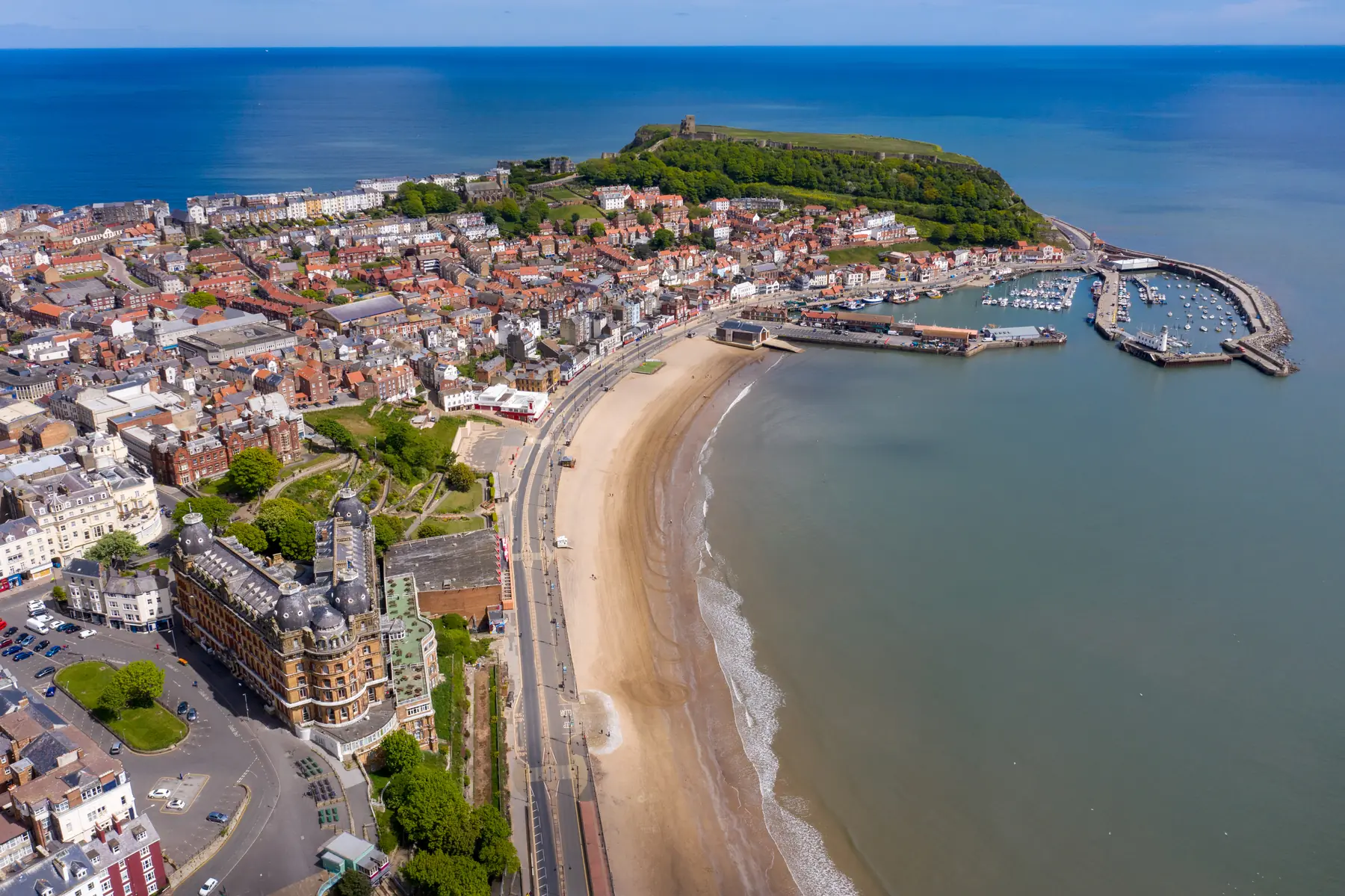
Scarborough exists because of its headland. A blunt promontory of rock pushes out into the North Sea between two sandy bays, with cliffs on three sides and a narrow neck joining it to the land — which is about as defensible a piece of ground as the English coast offers, and people have been using it for three thousand years.
The castle you visit is the Norman and medieval version, but it sits on top of everything that came before it, and the site is more interesting than the ruins alone would suggest.
An Iron Age settlement. The headland was occupied well before the Romans, and excavation has found evidence of a substantial late Bronze Age and Iron Age presence.
A Roman signal station. In the fourth century the Romans built one of a chain of watchtowers along this coast to warn of seaborne raiders. Its foundations are visible near the cliff edge.
A chapel. A small medieval chapel stands on the site of the signal station.
The Norman castle. A castle was established here in the twelfth century, and Henry II built the great keep — a huge square tower that dominated the headland until the Civil War took a large piece out of it.
The curtain walls and barbican, running across the narrow neck of the promontory, which is the only direction from which the castle could be attacked.
A master gunner’s house, eighteenth century, now the exhibition and shop.
The castle’s medieval history is a story of sieges. It was held against King John, held for and against various parties in the baronial wars, and was besieged repeatedly.
The most destructive episode was the English Civil War. Scarborough changed hands several times and the castle was besieged twice in the 1640s; a bombardment brought down the western wall of the keep, which is why it now stands as a half-tower open to the sky. It is one of the most striking ruins in the north of England precisely because of that damage.
The castle was used as a prison — George Fox, the founder of the Quakers, was held here in the 1660s — and later as a barracks.
Its last military moment came on 16 December 1914, when German battlecruisers shelled Scarborough, Whitby and Hartlepool from the sea. The castle barracks were hit and destroyed; so were houses across the town. It was the first significant attack on British civilians of the First World War and it killed and injured a considerable number of people. The bombardment became a recruiting slogan — “Remember Scarborough” — and the shell damage is still visible in the town.
English Heritage runs the castle, with an exhibition in the master gunner’s house, an audio tour and events through the summer.
The climb from the harbour or Castle Road is steep. Allow an hour and a half to two hours for the site.
The views are the real reason to go: both bays, the town, the coast running north towards Ravenscar and south towards Filey Brigg, and — on a clear day — a very long way out to sea.
The site is exposed. There is almost no shelter on the headland and the wind off the North Sea is serious. In a gale it is magnificent and slightly alarming.
St Mary’s Church sits on the slope below the castle and is free to enter. In its churchyard is the grave of Anne Brontë, the youngest of the three sisters, who came to Scarborough in May 1849 in the hope that the sea air would help her tuberculosis and died four days after arriving. She is the only one of the Brontës not buried at Haworth.
The old town below — Eastborough, Princess Street, Quay Street — is the medieval core of Scarborough, climbing from the harbour in narrow lanes.
Marine Drive runs right round the base of the headland, connecting the two bays at sea level. It is free to walk, it is closed when the sea comes over it, and in a heavy swell it is one of the best places on the east coast to watch the North Sea do its worst from behind a wall.
The headland divides Scarborough into two entirely different resorts.
South Bay is the older one: the harbour, the fishing fleet, Foreshore Road’s amusements and the Spa at the far end. The town grew here because it was sheltered, and the mineral spring that started the resort in 1626 comes out of the cliff at the southern end.
North Bay was developed later, largely after the railway arrived in 1845, and it is quieter and more spacious — Peasholm Park, the miniature railway, the open-air theatre and a wider beach.
Which one you use depends on the wind. Locals check before choosing, and so should you.
Getting there. On foot from the harbour up Castle Road, or from the old town. There is a free car park on Castle Road below the entrance.
Opening. English Heritage hours vary by season, with reduced winter opening. Check before travelling.
Accessibility. The approach and the site are steep and uneven; the exhibition is at the top.
Combine it with St Mary’s churchyard, the old town and Marine Drive for a half day.
Early morning for an empty headland and the light coming off the sea into South Bay. Late afternoon in summer, when the coach parties have gone and the low sun catches the keep. A clear winter day for the longest views — from the headland in good visibility you can see a very long way up and down the coast.
A gale is the other option, and it is the one people remember. The headland is entirely exposed and a North Sea storm up there is a physical experience. Hold on to hats, children and anything else loose, keep well away from the cliff edges, and enjoy it.
Standing on the castle walls is the clearest possible explanation of why Scarborough is where it is. Below on one side is the sheltered South Bay with its harbour, which is where the medieval town grew. On the other is the open North Bay, which nothing much happened on until the railway arrived in 1845 and the Victorians needed somewhere to build.
Inland, the valley of the Derwent runs away west — the natural transport route that brought traders to Scarborough Fair, armies to the castle and, eventually, the trains that made the town a resort.
You can read the whole history of the place from one hilltop, which is not something many English towns offer.
The Norman castle dates from the twelfth century, but the headland has been occupied since the Bronze Age and carries the remains of a fourth-century Roman signal station.
Civil War bombardment in the 1640s brought down its western wall. It has stood as a half-tower ever since.
Yes — German battlecruisers bombarded the town on 16 December 1914, destroying the castle barracks and killing civilians. It was among the first attacks on British civilians of the war.
An hour and a half to two hours, including the exhibition and the walk round the headland.
Yes, from every direction. There is parking on Castle Road just below the entrance.