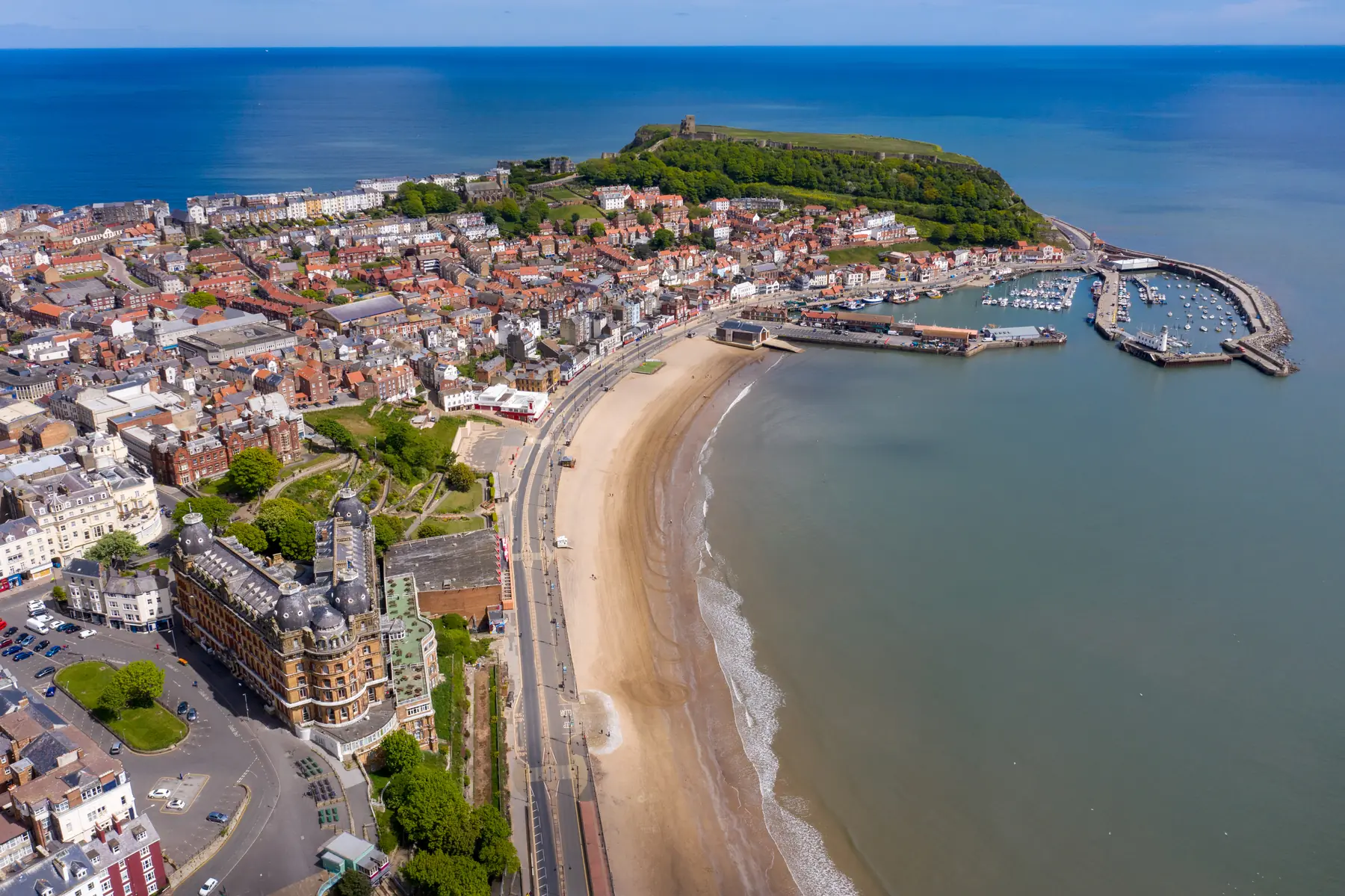
Scarborough is an inexpensive place to spend a day. Two sandy bays, one of the best municipal parks in England, a working harbour, a set of Victorian cliff gardens, a hill with the best view on the coast and a national trail running through the middle of it are all free.
It is also a real town rather than a resort strip, which means there is more to look at than there is to pay for.
South Bay — sand, the harbour, the amusements along Foreshore Road and the town rising behind. Donkeys in season. The traditional English seaside, and free.
North Bay — wider, quieter, sandier at low tide, with Peasholm behind it and considerably fewer arcades.
Cayton Bay, five kilometres south, is a wide surf beach in a wooded bay.
The promenades and the Marine Drive around the headland between the two bays are free to walk, and the Marine Drive in a heavy sea is a spectacle in its own right — though the road is closed when the waves come over it, which is not infrequent.
Free to enter and one of the finest municipal parks in the country. It opened in 1912 with an oriental theme that has been maintained ever since: a lake with a pagoda on an island, a cascade down the wooded slope, a bandstand on the water, and paths climbing through the trees.
The boats and the Naval Warfare — the model warship battles staged on the lake since 1929 — are charged, but walking round the park, watching the ducks and sitting by the lake are not.
Northstead Manor Gardens next door, with the open-air theatre and the boating lake, are also free.
The South Cliff Gardens climb the slope between the Spa and the Esplanade — Victorian cliff gardens restored in recent years, with the Italian Gardens, the rose garden, a Japanese garden and paths zig-zagging up the cliff. Free, and among the best public gardens on the east coast.
Falsgrave Park and the town’s smaller parks fill in the rest.
The lanes between the harbour and the castle are the oldest part of Scarborough and free to wander: narrow streets, cottages, chip shops and the fishing quarter.
The harbour still has a working fleet. Watching the boats land, the crab pots stacked on the quay and the gulls doing their worst is free and absorbing.
St Mary’s Church, below the castle, is free to enter and contains — in the churchyard — the grave of Anne Brontë, who came to Scarborough in 1849 hoping the sea air would help her tuberculosis and died four days later.
Oliver’s Mount, the hill south of the town, has a war memorial and a viewing point at the summit with both bays, the castle headland and the Wolds laid out below. Free to walk or drive up, and the best view in Scarborough.
The castle headland itself charges for the castle but the walk round the base on Marine Drive does not.
The national trail runs through the town, and it is free for all 110 miles. The sections either side are the best free walking here:
North to Scalby Mills, Cloughton Wyke and Hayburn Wyke, where a waterfall drops onto a boulder beach in a wooded ravine.
South to Cayton Bay and on to Filey Brigg, the rock promontory where the trail ends.
The Cinder Track, the old Scarborough to Whitby railway, is a level thirty-five kilometre walking and cycling route and free throughout.
Forge Valley, ten kilometres west, is a national nature reserve with a boardwalk through a wooded gorge — free, level and one of the best woodland bird sites in Yorkshire.
Scarborough’s calendar is busy. The open-air theatre in Northstead Manor Gardens is ticketed, but the town runs a substantial programme of free seafront events through the summer, and there are bands in the parks.
Armed Forces Day, the Seafest weekend and a run of harbour events are free to attend. And the surfing at Cayton Bay and the fishing off the piers cost nothing to watch.
The Yorkshire coast is one of the best fossil coastlines in Britain — the cliffs are Jurassic and they shed constantly. The beaches between Scarborough and Whitby, particularly around Cloughton and Hayburn Wyke, are good hunting ground for ammonites and belemnites, and it costs nothing.
Collect from the beach rather than the cliff face, keep away from the cliffs themselves, which slip regularly, and check the tide.
Less than you might expect. Several of Scarborough’s central car parks are free, including West Pier, North Street, Castle Road and Sea Cliff Road, and there are park and ride sites on the Seamer Road and Filey Road approaches for busy days.
The town also has a station in the middle of it with hourly trains from Manchester via Leeds and York, which makes a car-free day out entirely practical.
Start on South Bay by the harbour, walk up through the old town to St Mary’s and Anne Brontë’s grave, and round the castle headland on Marine Drive to North Bay. Spend the middle of the day in Peasholm Park and on the North Bay sands. Come back along the front, up through the South Cliff Gardens to the Esplanade, and finish with the climb up Oliver’s Mount for the view as the light goes.
Two beaches, a headland, a Victorian park and cliff gardens, and the best viewpoint on the Yorkshire coast, for nothing.
The first free day covered the town. The second should go up the coast. Walk or take the bus north to Scalby Mills, and follow the Cleveland Way along the clifftop past Scalby Ness and Cloughton Wyke to Hayburn Wyke, where a waterfall drops onto a boulder beach in a wooded ravine — about nine kilometres, free, with a pub at the top and a bus back.
Or go inland to Forge Valley, a national nature reserve of wooded gorge with a boardwalk trail, and on to Raincliffe Woods and Throxenby Mere. Level, free and almost always empty.
Worth checking. Scarborough Castle and Pickering Castle are English Heritage; Ravenscar, Robin Hood’s Bay’s Old Coastguard Station and stretches of the coast are National Trust. Neither is needed for anything on this page, but for a week on the Yorkshire coast an existing membership makes the paid list considerably shorter.
Yes, entry is free. The boats and the Naval Warfare shows charge.
Several central car parks are free, including West Pier, North Street and Castle Road, with park and ride on the approaches.
In St Mary’s churchyard below the castle. She died in Scarborough in 1849.
Yes — the Yorkshire coast is Jurassic and the beaches north of the town are good for ammonites and belemnites. Collect from the beach, not the cliff.
Oliver’s Mount, the hill south of the town, with both bays and the castle headland below.