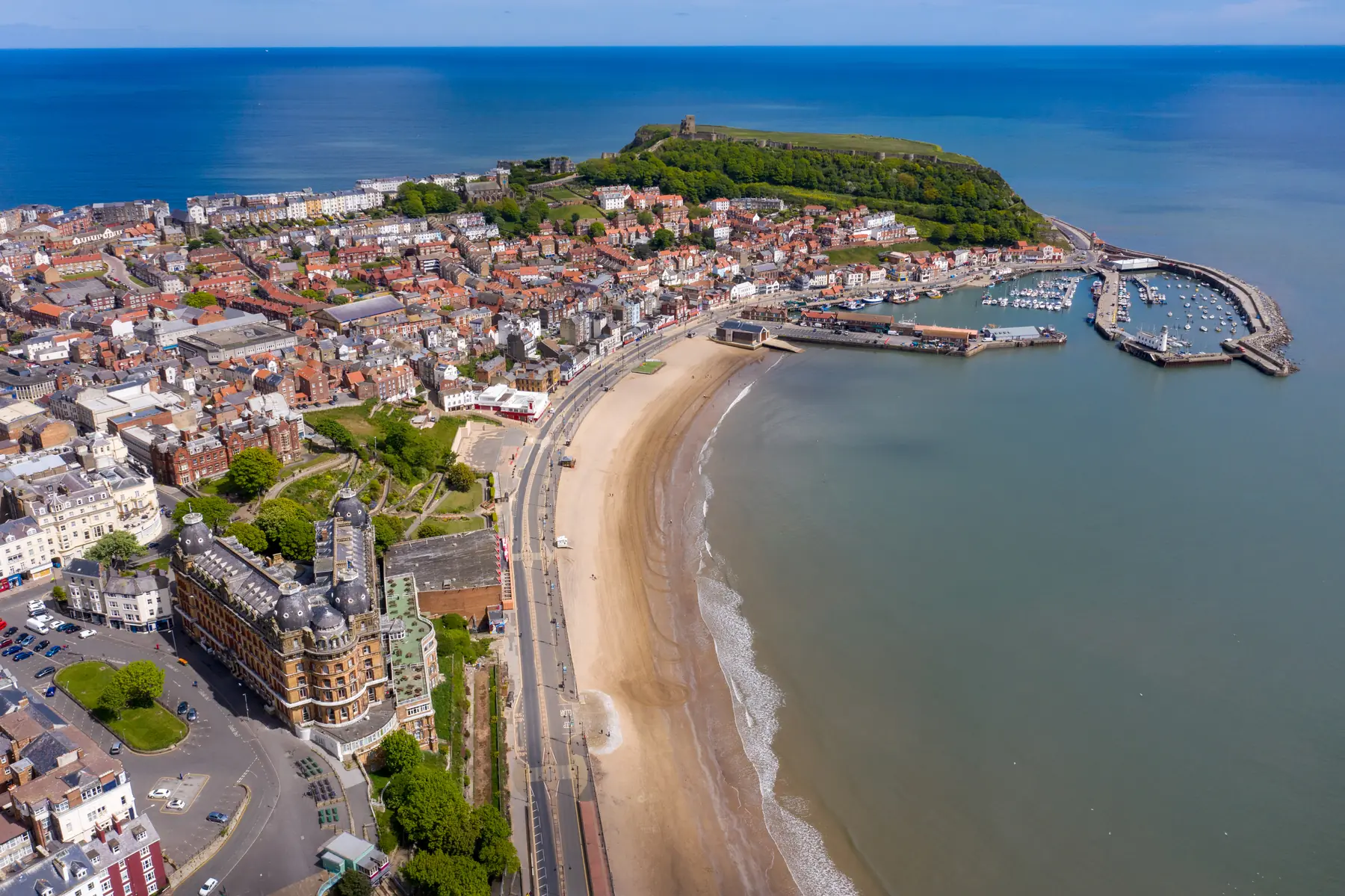
Scarborough sits between the North Sea and the North York Moors with a railway to York and a coast road running in both directions. Whitby is an hour north, Filey twenty minutes south, York an hour and a quarter west, and the moors begin about ten kilometres inland.
The one thing to know is that all routes to and from Scarborough clog on summer weekends — the A64 in particular narrows east of York and queues for miles. Going midweek, or going by train, transforms most of these trips.
Nineteen kilometres north. A village of red-roofed cottages tumbling down a ravine to a rocky shore, once the most notorious smuggling village on this coast — the houses are said to be connected by a network of passages through which contraband could pass from the beach to the top of the village without seeing daylight. It is steep, it is beautiful and it is busy in summer. Park at the top; the road down is not for the unwary.
The beach is one of the best fossil-hunting places in Britain, with ammonites in the rock ledges at low tide.
Thirty-five kilometres north, an hour by bus. The abbey ruin on the East Cliff, the 199 steps, the harbour, the whalebone arch, the Captain Cook Memorial Museum and the jet shops. It is also where Bram Stoker set Dracula’s arrival in England, which the town has monetised thoroughly. Superb fish and chips.
Between the two, the strange half-built resort at Ravenscar — laid out with streets and drains in the 1890s and then abandoned when nobody bought the plots — sits on a clifftop above the old alum works. The National Trust has a visitor point and the walk down to the shore is dramatic.
Eleven kilometres south, twelve minutes by train. Miles of firm flat sand in a great bay, a Victorian seafront and Glen Gardens behind it, and Filey Brigg — a narrow rock promontory running out to sea, where the Cleveland Way ends. Quieter and more old-fashioned than Scarborough, and the better beach of the two.
Thirty kilometres south. A chalk headland with two lighthouses, sea caves and dramatic white cliffs. Next to it, RSPB Bempton Cliffs holds one of the largest seabird colonies in England — half a million birds in the season, including gannets, puffins, guillemots and kittiwakes, viewed from clifftop platforms. April to July is the season and it is one of the great British wildlife spectacles. Bempton has its own station on the Hull line.
Thirty-five kilometres south. A larger, brasher resort with a harbour, a long beach and the Old Town a mile inland, which is considerably more interesting than the seafront.
Twenty-five kilometres west. Pickering Castle is a motte-and-bailey fortress where Richard II was briefly held in 1399, and the Beck Isle Museum covers rural life. But the reason to come is the North Yorkshire Moors Railway, which runs steam trains from Pickering across the moors to Grosmont and on to Whitby — one of the best heritage lines in Britain and a superb thing to do in any weather.
The national park begins about ten kilometres inland: heather moorland that is spectacular in August, the Hole of Horcum amphitheatre, the villages of Levisham, Goathland and Hutton-le-Hole, and Rievaulx and Byland abbeys further west.
Ten kilometres west, a wooded gorge with a boardwalk nature trail — the easiest woodland walk near the town.
Seventy kilometres, an hour and a quarter by road or by train. The Minster, the walls, the Shambles, Jorvik, the National Railway Museum and a city’s worth of shopping. The obvious full day out, and the train makes it easy.
Fifty kilometres west, near Malton. Vanbrugh’s baroque palace in a landscaped park, with the mausoleum, the temple and the gardens. One of the great English houses and a comfortable day out.
Malton has become Yorkshire’s food town, with a monthly market and a cookery school. South of it, the Yorkshire Wolds are chalk hills of dry valleys and big skies, largely empty, with the Wolds Way running through them.
Better than most of the Yorkshire coast. TransPennine Express runs hourly from Manchester Victoria via Huddersfield, Leeds, York and Malton — which means York, Malton and Castle Howard are all straightforward. Northern runs every two hours down the coast to Filey, Bempton for Flamborough, Bridlington and Hull.
North of Scarborough there is no railway — the line closed and is now the Cinder Track — but buses run up the coast to Cloughton, Ravenscar, Robin Hood’s Bay and Whitby, which is a fine journey in itself.
The station is in the middle of town next to the bus stand. Our getting here page has more.
The coast day, by bus. North along the coast road to Robin Hood’s Bay in the morning — the village down the ravine, the beach and the fossils at low tide — then on to Whitby for the abbey, the harbour and lunch, and back in the late afternoon. No driving, no parking, and one of the best bus journeys in England.
The moors and steam day. West to Pickering for the castle and the Beck Isle Museum, then the North Yorkshire Moors Railway across the moors to Goathland and Grosmont, with the option of continuing to Whitby and returning along the coast by bus.
The seabird day. South by train to Bempton for the RSPB cliffs — half a million seabirds between April and July, including gannets and puffins — then on to Bridlington or back via Filey for the beach. Entirely by rail.
The A64 is the artery west and it narrows east of York, where it queues for miles on summer weekends and bank holidays. The coast road north to Whitby is slower than it looks. And the honeypots — Robin Hood’s Bay, Whitby, Goathland — fill their car parks by mid-morning in season.
The trains and the coastal buses solve most of this, and the journeys themselves are part of the day.
Whitby for a full day, Robin Hood’s Bay for a half day, York if you want a city.
Thirty-five kilometres north, about an hour by bus along the coast road.
Yes, hourly, in about an hour and a quarter.
RSPB Bempton Cliffs, thirty kilometres south, between April and July. Bempton has its own station.
Yes — steam across the moors from Pickering to Grosmont and on to Whitby, and one of the best things to do inland from this coast.